Climate Corner: A Conversation with White Snake Projects’ Cerise Lim Jacobs
Cerise, thank you for chatting today. Let’s dive into To the People Like Us, your upcoming commission premiering this month. How did the piece come to be?
I’ve always believed the divide between “high art” and “low art” is false, created by Eurocentric gatekeepers. Community artmaking often gets labeled as “low art” because it’s under-resourced. At White Snake Projects, we aim to challenge that and build community trust. That began with Show Out Boston, which we’ve now done four times. We rent Hibernian Hall and invite youth performing arts groups—spoken word, dance, classical music—and give them honorariums, meals, and a platform to perform and network.
One regular participant was 826 Boston, so two years ago I approached them about doing something more ambitious. They’re an after-school group active in the Boston Public Schools, including the International Newcomers Academy (BINcA), which serves recent immigrant families. I had worked with them before on songwriting, so this was a natural next step. We expanded into writing a libretto together, working with their student writers’ group, YLAB.
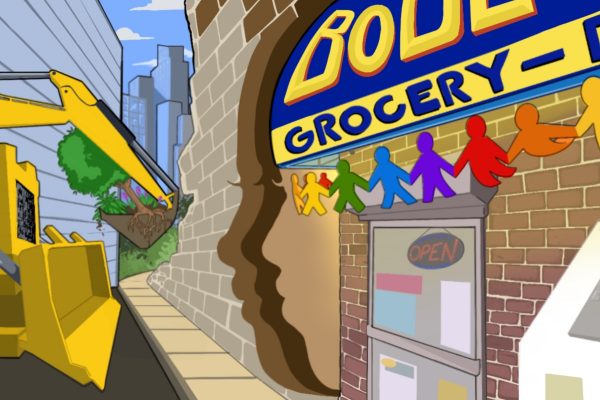
These teens came up with everything—the theme of gentrification, the characters, the storyline. We helped shape their words into a libretto singable by professional opera singers. Composer Jorge Sosa, a frequent collaborator of ours, wrote the music. He created an incredible score blending bolero, salsa, pop, and rock that was reflective of the youth and backgrounds of the student writers. I brought on a top-notch creative team: Pascale Florestal, who just won the Elliot Norton Award for Best Director, and Chloe Moore, who won for Best Costume Design. The result is a mainstage show with high production values, that began as community artmaking.
Too often, community engagement is brief and doesn’t last. We’re committed to long-term relationships. 826 already wants to do this again, so this project will return as a biennial series.
Let’s talk about climate. How does it show up in To the People Like Us? And how did the students come to it?
Our programming is thematic by calendar year. In 2024, an election year, the theme was voting. We premiered Is This America?, based on Fannie Lou Hamer’s speech at the 1964 DNC in addition to a year-long series of community performances, panel discussions, and gatherings around the theme.
2025 is our climate year. Our Sing Out Strong series this year is titled Environmental Voices, with the prompt “What does climate change mean to you and your generation?” We wanted multigenerational input and went back to our partners at BINcA. We held a sort of contest for student lyrics and paid the winners who became part of our climate song series, which launched at the Josiah Quincy School with Boston Music Project.
Since then, we’ve performed at the Brookline Public Library, the New England Aquarium on World Oceans Day, and we’ll appear at a farmer’s market and another event in October.
This opera touches on climate because gentrification removes more than just people—it removes green spaces, local stores, and places where culture and community flourish. We’re staging the show at The Strand Theatre in Dorchester, which is the hottest spot in Massachusetts—literally. Lower-income communities are disproportionately impacted by climate change, and this show speaks to that.
Later this year, we’ll present White Raven, Black Dove, set in a dystopian future after the Sixth Extinction—accelerated and triggered by human activity. The surface world is dominated by one group with resources, while another is forced underground. The show explores adaptation and survival, and the price of inaction.
It’s great to hear about this collaborative model and the ambition to keep building on it.
We’re very ambitious. This is just the first version—next time, we hope to add student composers under Jorge’s mentorship, each writing an aria. Writing for voice is a unique skill, and this will allow us to expand our community creativity even more.
How were the student writers chosen?
They self-selected. YLAB is a group of about 12 teens passionate about writing, led by a writer from 826. When 826 and I discussed the project, we knew this was the group to start with. They were new to libretto writing, but they were dedicated to learning!
Have you seen some students really connect with this and grow creatively?
Yes, absolutely. I explained the collaborative nature of opera writing. Jorge would sometimes need more or fewer words, or repetition for musical motifs. To preserve the students’ vision, we created a paid student consultant group to review and approve changes during the summer. That feedback loop was powerful.
How long did the project take?
About a year and a half. In opera, that’s light speed—these projects usually take 3–5 years or more. But our model is different. White Snake only produces new work, and we can’t afford to develop something for five years. Our commission pipeline already goes into 2029, so we work faster.
Other companies might do multiple workshops and never get to production. We believe in getting the work on its feet. Our rehearsal process doubles as a development process, with composers in the room. It’s a model closer to musical theater. If you’re on a limited budget, do you spend it on workshops that might not go anywhere—or do you take a risk, produce the work, and refine it through performance?
That’s how our opera I Am a Dreamer Who No Longer Dreams went on to tour nationally and premiered in Mexico City. You have to put the work out into the world.
And because your work engages timely issues, the urgency matters. If you took longer—
It might never be staged! Timeliness is crucial, especially with activist work like ours.
So your shows anchor a broader year of engagement.
Exactly. The performances are just one part. We build ecosystems around our productions—community artmaking, panel discussions, and school partnerships. We want people to feel that the art is part of something larger. These stories don’t stand alone.
Thank you, Cerise, for your time, insight, and the vital work you’re doing with White Snake Projects.
Thank you. I appreciate the opportunity to share the context for To the People Like Us and our broader mission.
To the People Like Us will be performed at the Strand Theatre on July 28, 2025, at 2PM and 7PM. Reserve your FREE tickets at the White Snake Projects website.